
Product reviews drive conversion. Going from 0 to 5 reviews can increase conversion 10-30%. But most customers don't leave reviews - they have no reason to.
Store credit fixes this. Offer $5 for a review, and review volume increases 3-5x. The key: reward any review (1-star or 5-star), not just positive ones. This keeps reviews honest and credible.
This article covers T1TAN's €2/€4 tiered approach, timing, honesty framing, and automation via Shopify Flow.
Why Store Credit > Discount Codes
Problem with discount codes:
"Leave a review, get 10% off your next order."
Customer leaves review → gets code → may never use it (forgot, expired, lost email).
Store credit advantage:
"Leave a review, earn $5 credit."
Credit appears in customer's account automatically. Visible at checkout. Customer will use it (utilization rate 25-40% vs. 10-15% for codes).
Credit also brings them back. Code is a one-time thing. Credit balance pulls them to return ("I have $5 waiting").
Tiered Incentives (T1TAN Model)
T1TAN (sports gear brand) offers:
- Text review: €2
- Photo review: €4
- Video review: €4
Why tiered works:
Photos and videos are more valuable (social proof, UGC for ads). Offering more credit for higher-effort reviews increases photo/video submissions by 40-60%.
Recommended amounts:
- Text: $5
- Photo: $10
- Video: $20
Adjust based on margin. If margin is low (<30%), use $2/ $5/ $10.
Timing: 7-10 Days Post-Delivery
Ask too early (before product arrives) → customer can't review yet.
Ask too late (60+ days) → customer forgot about the product.
Optimal window: 7-10 days post-delivery.
Why:
- Product has been used (customer has an opinion)
- Experience is fresh (details are memorable)
- Customer is still engaged with your brand
How to automate:
Klaviyo flow:
Trigger: Order fulfilled (+ 7 day delay)
Email: "How's your [product]? Leave a review and earn $5 credit."
Honesty Framing
Key principle: Reward any review, not just positive ones.
Bad framing:
"Love your purchase? Leave a 5-star review and get $5!"
This biases reviews upward and violates platform policies (FTC, Amazon, Google).
Good framing:
"Share your honest feedback - good or bad - and earn $5 credit. Your review helps other customers make informed decisions."
Why it matters:
- Credibility: Mixed reviews (some 4-star, some 5-star) are more trustworthy than all 5-star.
- Compliance: Platforms prohibit incentivizing positive reviews. Incentivizing any review is allowed.
- Actionable feedback: Negative reviews tell you what to fix. Suppressing them costs you product improvement insights.
T1TAN approach:
Explicitly states "we value honest reviews" in request email. Doesn't ask for star rating - just asks for experience. Result: 4.8/5 average (high, but not suspiciously perfect).
Automation: Shopify Flow + memberr
Setup:
- Trigger: Review submitted (via Judge.me, Reviews.io, Loox)
- Condition: Review is verified purchase
- Action: memberr "Reward Review" node
- Has Photo: Yes/No
- Has Video: Yes/No
memberr automatically calculates credit amount based on your settings.
memberr settings (Reviews tab):
- Text review: $5
- Photo review: + $5 (total $10)
- Video review: + $15 (total $20)
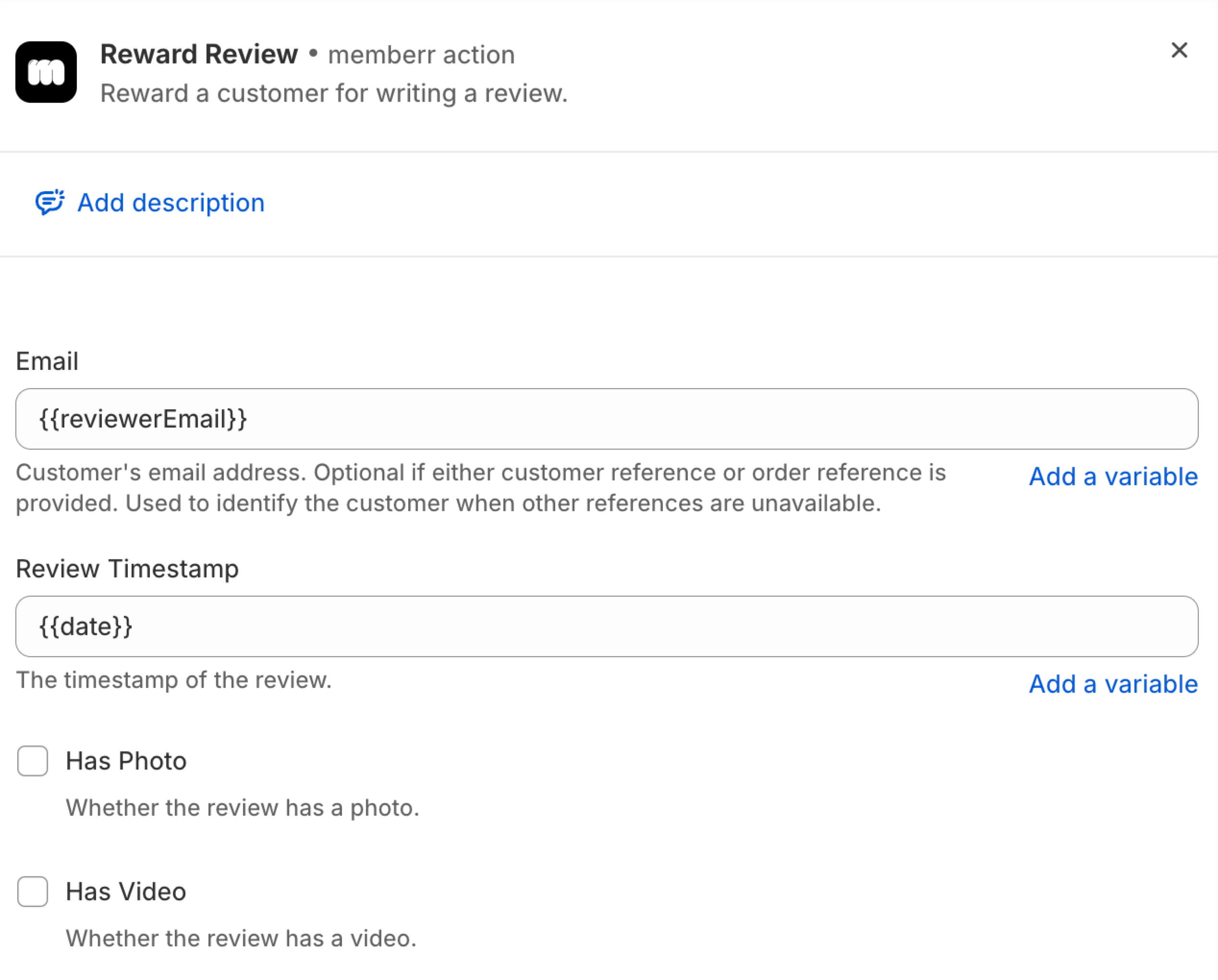
Flow example:
Credit is issued immediately. Customer receives email: "Thanks for your review! We've added $10 to your account."
Docs: memberr Shopify Flow Integration
Judge.me vs. Reviews.io Integration
Judge.me
Setup:
Judge.me (Awesome plan, $15/mo) > Settings > Integrations > memberr
Enter memberr API key. Judge.me sends review events to memberr automatically.
Advantages:
- Built-in integration (no Flow needed)
- Cheaper ($15/mo vs. Reviews.io $45/mo)
- Auto-rewards based on photo/video detection
Limitation:
Requires Awesome plan (free plan doesn't support integrations).
Reviews.io
Setup:
Use Shopify Flow as bridge:
Trigger: Reviews.io review submitted (webhook)
Action: memberr Reward Review
Advantages:
- More advanced features (in-email review forms, Google integration)
- Higher-tier plans available for enterprise
Limitation:
More expensive. Requires Flow setup (vs. Judge.me's direct integration).
Recommendation:
Most stores: Judge.me (cheaper, easier).
Enterprise: Reviews.io (more features).
Communication: Request → Reward → Reminder
1. Review Request (Email)
Subject: "How's your [product]?"
Body:
Key elements:
- Honest (not "tell us how much you love it")
- Clear incentive ($5 text, $10 photo)
- Direct link to review form
2. Credit Issued (Confirmation Email)
Subject: "Thanks for your review - $10 credit added"
Body:
Why send this:
Confirms credit was applied. Encourages immediate return visit to use it.
3. Balance Reminder (If Not Used Within 30 Days)
Subject: "You have $10 credit waiting"
Body:
Why send this:
Customers forget. Reminder increases utilization 15-25%.
Best Practices
1. Verified Buyers Only
Only reward reviews from customers who actually purchased. This prevents:
- Fake reviews from non-buyers
- Competitor manipulation
- Spam
Judge.me and Reviews.io automatically tag verified purchases. Only reward those.
2. One Reward Per Product Per Customer
Don't allow customers to leave 10 reviews on the same product for $50 credit.
memberr handles this automatically: Tracks which products a customer has reviewed, prevents duplicate rewards.
3. Moderate Before Rewarding (Optional)
If you manually approve reviews before publishing, configure Flow to reward only after approval (not just submission).
Flow logic:
Trigger: Review approved (not "Review submitted")
Action: Reward Review
This prevents rewarding spam or inappropriate reviews.
4. Expiry: Optional
Review credit can be evergreen (no expiry). Why?
- Goal is social proof, not urgency
- Customer may redeem 6 months later (still a repeat purchase)
- No expiry = simpler (customer doesn't feel rushed)
Exception: If you want to drive immediate redemption, use 30-day expiry.
5. Display Incentive on Product Pages
Add note near review section:
"Leave a review and earn $5 store credit ($10 with photo)."
This primes customers before they buy: "If I buy this, I can earn credit by reviewing." Increases review intent.
Expected Results
Before incentive program:
- Review rate: 2-5% of orders
- Photos: 10-20% of reviews
- Videos: <5% of reviews
After incentive program:
- Review rate: 10-20% of orders (3-5x increase)
- Photos: 40-60% of reviews (tiered incentive works)
- Videos: 10-15% of reviews (still low, but significant for UGC)
Cost:
$10 average credit per review. If review helps convert 2 extra customers per month (conservative), payback in 30 days.
T1TAN results:
€2/€4 tiered model. Review volume increased 4x in 6 months. 60% of reviews include photos (used in ads and social). Cost per review: €3 average. LTV increase from reviewers (repeat purchase): 35%.
Common Mistakes
Mistake 1: Only rewarding 5-star reviews
Violates platform policies. Biases results. Lose credibility.
Fix: Reward all reviews equally.
Mistake 2: No photo/video tier
Miss out on UGC. Photos convert 3x better than text-only reviews.
Fix: Offer $5/ $10/ $20 tiers.
Mistake 3: Asking too early
Customer hasn't received product yet. Can't review.
Fix: Wait 7-10 days post-delivery.
Mistake 4: No credit confirmation
Customer leaves review, doesn't know if credit was issued, never returns.
Fix: Send confirmation email immediately.
Mistake 5: No reminders
Customer earned $10 credit, forgets, never uses it.
Fix: Send reminder 30 days post-review if not redeemed.
Store credit turns reviews from a favor into a transaction: "I give you feedback, you give me credit." Both parties benefit. Customer gets value, you get social proof.
Set up once, automate via Flow, and watch review volume increase 3-5x without biasing ratings.
For Flow setup, see Shopify Flow + Store Credit.
For review settings in memberr, see memberr Docs: Reviews.